What Is Automatic Speech Recognition (ASR) and How Does It Work?

What Is Automatic Speech Recognition (ASR)?
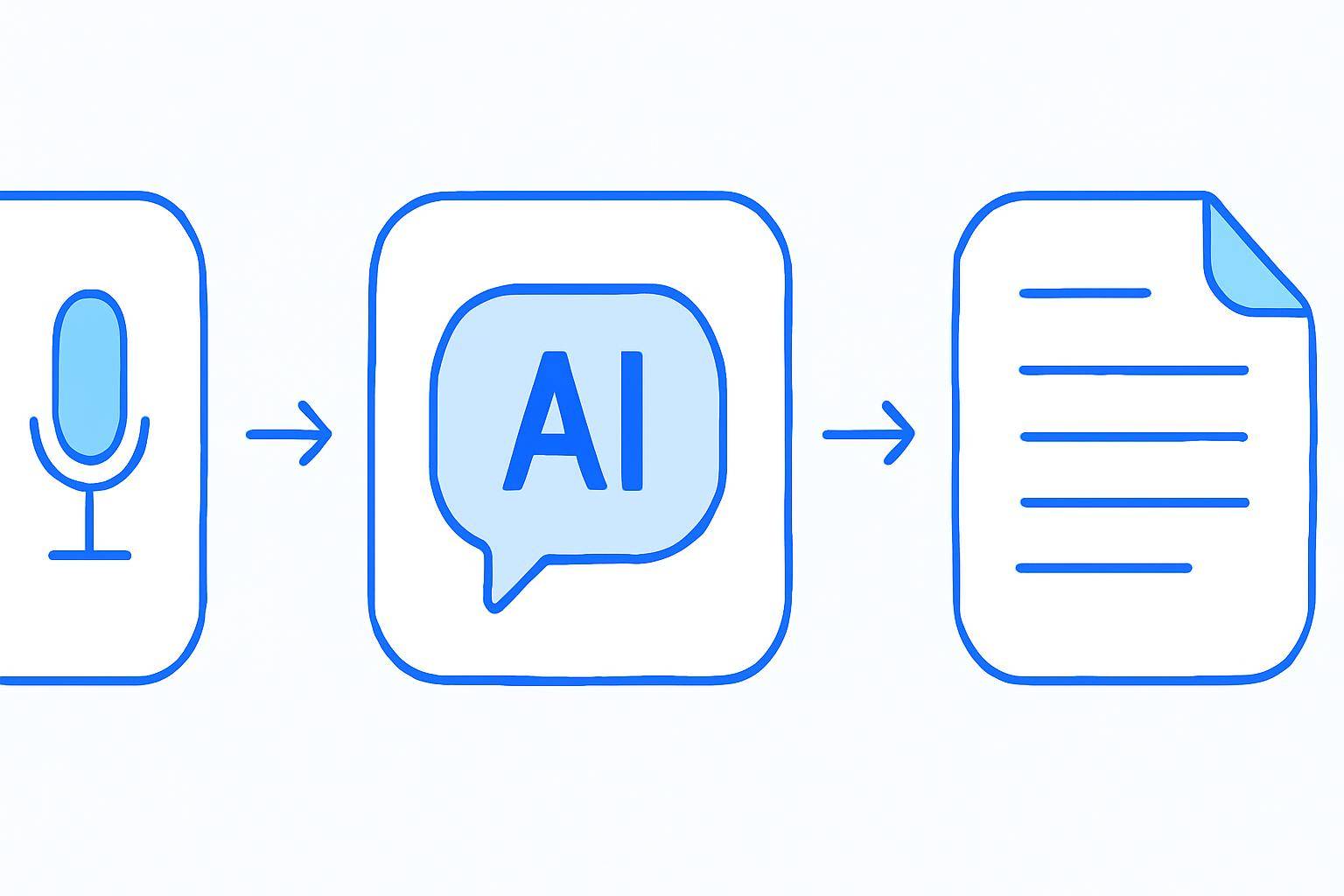
Automatic speech recognition (ASR) is the technology that enables machines to interpret spoken language and convert it into written text. ASR bridges the gap between human speech and digital text, allowing computers to "listen" and understand audio from sources like videos, phone calls, meetings, and more. This process forms the backbone for applications such as voice assistants, live captions, and AI video transcription services.
ASR works by analyzing audio signals, identifying words and phrases, and outputting them as readable text. The process leverages advanced machine learning techniques, large datasets, and natural language processing (NLP) to achieve high accuracy—though not perfect—across diverse accents, languages, and environments.
For anyone working with video or audio content, ASR offers a practical way to create transcripts, captions, and searchable text. Tools such as AIVideoSummary make it simple to upload a video or paste a URL and receive an AI-powered transcript or summary in minutes. This makes content more accessible, discoverable, and usable.
How Does Automatic Speech Recognition Work?
ASR systems may seem like magic, but under the hood, they follow a well-defined technical workflow. Let's break down the main steps involved:
Step 1: Audio Input and Preprocessing
- Capture Audio: The process begins with an audio source—such as a video, phone call, or live microphone feed.
- Noise Reduction: Background noise and interference are filtered to enhance voice clarity.
- Segmentation: The system divides the audio into small frames or segments for detailed analysis.
Step 2: Feature Extraction
- Spectrogram Generation: Audio is converted into a visual representation (spectrogram) that illustrates frequency and amplitude over time.
- Acoustic Feature Extraction: ASR systems extract relevant features (like pitch, energy, formants) that help identify phonemes (basic speech units).
Step 3: Acoustic Modeling
- Phoneme Recognition: Machine learning models analyze features to detect phonemes and map them to language sounds.
- Deep Neural Networks: Modern ASR uses deep learning (e.g., CNNs, RNNs, Transformers) to improve phoneme and word recognition.
Step 4: Language Modeling
- Contextual Prediction: The system uses statistical or neural language models to predict word sequences based on context, grammar, and probability.
- Error Correction: Words that fit poorly in context may be auto-corrected using dictionaries or domain-specific language models.
Step 5: Decoding and Output
- Transcription Generation: The recognized words are combined into a text transcript.
- Punctuation and Formatting: Modern ASR systems add punctuation and structure for readability.
- Timestamp Alignment: For captioning or subtitles, text is synced to audio timestamps.
ASR Workflow Illustrated
- Input audio or video file
- Preprocessing and noise reduction
- Feature extraction (spectrogram)
- Acoustic and language modeling
- Decoding and generation of readable text
- Output transcript, subtitles, or summary
For a hands-on example, try uploading or pasting a video URL to AIVideoSummary’s video transcription tool.
Key Technologies Behind ASR
ASR has evolved rapidly due to advancements in several areas:
- Machine Learning and Deep Learning: Modern ASR relies on large neural networks trained on massive datasets to recognize complex speech patterns.
- Natural Language Processing (NLP): NLP models provide context, grammar, and disambiguation for more accurate transcriptions.
- Big Data and Cloud Computing: Large-scale models require significant data and computational power, often delivered via cloud services.
- Speech Corpora: Diverse, multilingual datasets help systems learn various accents, dialects, and speech conditions.
Comparison: Traditional vs. AI-Powered ASR
| Feature | Traditional ASR | Modern AI-Powered ASR | |------------------------|---------------------------|-------------------------------| | Technology | Rule-based, HMMs | Deep learning (DNN, RNN, Transformers) | | Accuracy | Moderate, context-limited | Higher, context-aware | | Language Support | Limited | Broad, multilingual | | Adaptability | Manual tuning required | Learns from new data | | Handles Accents/Noise | Struggles | Robust to diversity/noise | | Speed | Moderate | Near real-time | | Scalability | Limited | Highly scalable (cloud-based) | | Applications | Dictation, IVR | Video, live captions, chatbots, transcription |
Curious about AI vs. human accuracy? See our in-depth analysis of AI transcription accuracy.
Practical Applications of Automatic Speech Recognition

ASR powers a wide range of real-world applications:
- AI Video Transcription: Convert spoken content from lectures, interviews, webinars, and YouTube videos into searchable text. Learn how to transcribe video to text using AI.
- Automatic Subtitles and Captions: Make videos accessible to deaf and hard-of-hearing users, and improve engagement for all viewers. Explore perfect subtitles and accurate timestamps.
- Meeting Notes and Summaries: Automatically generate summaries and action points from business meetings.
- Voice Assistants and Chatbots: Power smart devices and virtual agents that understand spoken commands.
- Legal, Medical, and Educational Transcription: Speed up documentation in specialized domains. See AI transcription for legal, medical, and education sectors.
- Podcast and Content Searchability: Make audio and video archives fully searchable by converting speech to text.
Example: Transcribing a YouTube Lecture
Suppose you have a one-hour recorded lecture on YouTube. By pasting the video URL into AIVideoSummary, the ASR system will process the audio, transcribe the speech, and deliver a structured transcript and summary—saving hours of manual note-taking.Benefits and Limitations of ASR
Key Benefits
- Accessibility: Enables captions, subtitles, and transcripts for people who are deaf or hard of hearing.
- Searchability: Makes spoken content indexable and searchable, improving SEO and user experience.
- Productivity: Automates note-taking and documentation, saving time.
- Localization: Supports translation and dubbing workflows.
Real-World Limitations
- Accuracy Varies: ASR is highly accurate for clear, standard speech, but may struggle with heavy accents, overlapping voices, jargon, or noisy environments.
- Context Matters: Homophones, slang, and domain-specific vocabulary can lead to errors without domain adaptation.
- Privacy/Security: Cloud-based ASR may require uploading sensitive audio; always review provider policies.
- Language and Dialect Support: Some languages or dialects may be less well-supported due to limited training data.
To understand more about the factors impacting ASR accuracy, check out our guide on AI subtitle accuracy.
How to Use ASR for Video Transcription and Summarization
If you want to try ASR for your own videos or audio files, the process is straightforward with modern tools:
- Record or obtain your audio/video file.
- Upload the file or paste a video URL into an ASR tool, like AIVideoSummary.
- Wait for the system to process and transcribe the speech.
- Review, edit, and export the transcript, subtitles, or summary as needed.
You can explore the features and pricing for various ASR-powered services to find the best fit for your workflow.
Advanced Topics: Improving ASR Performance
Custom Vocabulary and Language Models
For specialized fields (e.g., medicine, law, academia), custom vocabularies and language models help ASR systems better recognize technical terms and names.Speaker Diarization
Some ASR solutions can identify and label different speakers within a conversation, which is useful for meeting transcriptions.Real-Time Captioning
Live ASR enables real-time subtitles for broadcasts, conferences, and online meetings, making content instantly accessible.Human-in-the-Loop Editing
Even the best ASR systems benefit from human review and correction, especially for critical applications like court proceedings or medical records. Learn more about AI-assisted blog post rewriting to streamline your editing process.Choosing the Right ASR Solution
When selecting an ASR tool, consider the following factors:
- Accuracy: Does it support your language, accent, and use case?
- Speed: Is real-time or batch processing needed?
- Security: Are your files handled with appropriate privacy measures?
- Integration: Can it connect with your existing workflow (e.g., video platforms, content management systems)?
- Cost: Does the pricing structure match your usage needs? Explore AIVideoSummary's pricing for transparent options.
The Future of Automatic Speech Recognition
ASR technology continues to improve, with trends including:
- Multilingual and Code-Switching Support: Better handling of mixed-language conversations.
- Emotion and Sentiment Recognition: Understanding not just words, but tone and intent.
- Edge Computing: Running ASR models locally on devices for privacy and speed.
- Personalization: Adapting models to individual users and contexts.
FAQ: Automatic Speech Recognition (ASR)

Frequently Asked Questions
#### What affects the accuracy of automatic speech recognition? ASR accuracy depends on factors like audio quality, speaker clarity, background noise, accents, and the system’s training data. Specialized jargon or multiple overlapping speakers can also impact results. For best outcomes, use high-quality recordings and consider tools that support domain-specific models.
#### Can ASR transcribe videos in real-time? Many modern ASR systems offer real-time or near real-time transcription, enabling live captions for meetings, lectures, and broadcasts. However, real-time accuracy may be slightly lower compared to batch processing due to speed constraints.
#### How secure is my data when using cloud-based ASR services? Security varies by provider. Reputable ASR services use encryption for data in transit and at rest, and may offer on-premises options for sensitive content. Always review the privacy policy and data handling practices before uploading confidential files.
#### Can ASR handle multiple languages and accents? State-of-the-art ASR systems support dozens of languages and are trained on diverse accents. However, rare dialects or language mixing may reduce accuracy. It’s wise to test your specific use case with a sample file.
#### Is ASR suitable for legal, medical, or educational transcription? Yes, especially when paired with domain-adapted language models and human review. AIVideoSummary offers specialized solutions for legal, medical, and education sectors.
#### What are common limitations of automatic speech recognition? ASR may misinterpret homophones, struggle with heavy accents, or fail in noisy environments. It may also have difficulty with domain-specific terminology unless customized. Human review is recommended for critical transcripts.
#### How can I get started with ASR-powered video transcription? You can start by uploading your video or pasting a URL into AIVideoSummary. The platform will automatically transcribe and summarize your content, making it easier to search, share, and repurpose.
---
Automatic speech recognition is transforming the way we interact with spoken content. While it’s not flawless, today’s AI-powered ASR tools offer fast, accessible, and scalable solutions for video transcription, subtitles, and more. Try AIVideoSummary to see how easy it is to unlock the full potential of your audio and video assets.